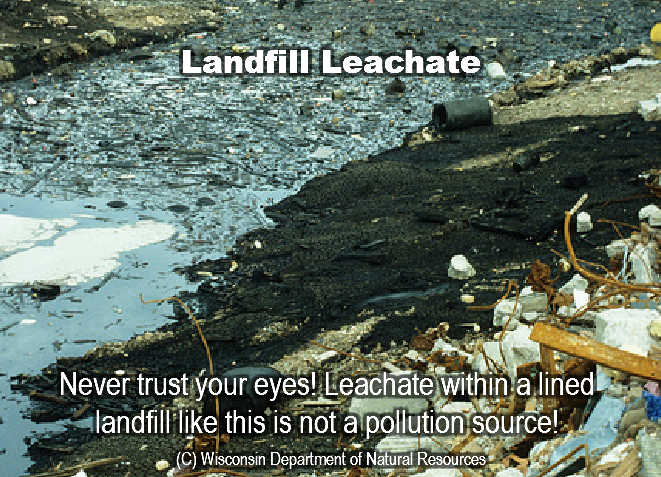
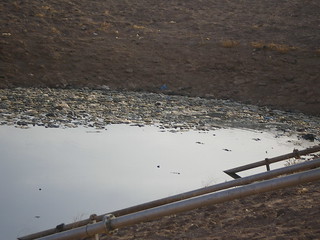
When landfills are lined, as almost all of them are now, the leachate is collected and sooner or later even after treatment to a high quality standard, it has to be disposed of off-site in some way. That's where leachate pumping and the pumps that are needed to accomplish it come into the news.
In our first article the issue is aired as to whether a leachate discharge into a United States River should be allowed.
Leachate Trickling out of a landfill usually needs to be pumped
(Image by indiawaterportal.org via Flickr)
To put it simply, the landfill operator wants to reduce costs by avoiding sending their leachate to the sewage works via the public sewer or a tanker vehicle.
The operator says that they can make a discharge which complies with the reasonable requirement of not reducing the water quality in the river, and no doubt they have good evidence to show that this is possible, because their are many hundreds if not thousands of river discharges of treated leachate effluent which make discharges to rivers without casing pollution.
Read on to learn more, about this issue:
Landfill owner wants to pump leachate into Shenango
SHENANGO VALLEY – After having polluted water from its River Road landfill treated for almost 30 years at the Sharon sewage treatment plant, Waste Management of Pennsylvania, Inc., thinks the leachate from its landfill that closed in 1986 may be safe enough to discharge untreated into the Shenango River.
The company has been working for two years with the state Department of Environmental Protection and federal Environmental Protection Agency and recently submitted its plan for a pilot program “to demonstrate equivalency between pumping and not pumping,” said Glenn Schultz, Waste Management’s senior project manager for the landfill. It occupies 371/2 acres of a 102-acre parcel in South Pymatuning Township and Hermitage.
Waste Management would stop pumping leachate for treatment for two years and would monitor effects on the river, he said.
“The chemistry will speak for itself,” Schultz said. “If we need to reactivate the system, that’s what we’ll do.”
Leachate that percolates through the mountain of industrial and municipal waste now covered with a grassy dirt cap collects in a gravel-filled trench. It also collects surface water and river water and the mixture, about 38,000 gallons a day or 1.1 million gallons a year, according to Dale Bucher of Upper Shenango Valley Water Pollution Control Authority, is pumped into sewer lines for treatment along with municipal waste. The Sharon plant discharges treated water into the river.
Under the landfill closure agreement with DEP, the Sharon plant tests the discharge for metals, polychlorinated biphenyl compounds and volatile organic compounds from River Road. Among a dozen metals, the primary contaminants of concern, according to the EPA, are cadmium and zinc.
PCBs from the manufacture of electrical transformers and trichloroethylene, or TCE that was used to clean grease from metals, are among the pollutants associated with area manufacturing during the years the landfill was accepting waste.
The site was removed from the National Priorities List of most hazardous waste sites, also known as the Superfund list, in January 2004. In its five-year reviews, the most recent in September 2014, EPA said it has found that remedies required at the site “remain protective of human health and the environment.”
EPA spokesperson Bonnie Smith said the agency has set no time frame for a decision on Waste Management’s application.
“There are reports going back and forth between the agencies to make sure that if we make a decision to go ahead that we have all the science we need and information about the water and sediments before we would begin a pilot which would include very specific standards for monitoring,” she said. “We’re taking it seriously because we want the Shenango River to remain at least at the quality it is now.”
Waste Management also would have to receive a federal permit from the National Pollutant Discharge Elimination System to release water into public waterways. Under EPA’s partnership with the state, the permit would be issued by DEP.
“We have to have all the science up front, both for the pilot and for the discharge permit,” Smith said. “If results of the pilot bear out what the science seemed to say, they could discharge leachate and surface water into the river.”
Waste Management would have to maintain water quality standards under the permit if one is granted and also continue to meet standards for pollutants in sediment and effects on aquatic life at the landfill and in the river that are separate from water-quality issues. Those standards come from River Road’s former listing on the Superfund list, she said.
Upper Shenango and Sharon Sanitary Authority stand to lose revenue if discharges into the river are allowed. Waste Management pays about $7,500 a month to Upper Shenango, money it uses to pay the Sharon authority for treatment and for bond payments.
“It really isn’t about the revenue,” said Guy Cunningham, manager of the Sharon authority. “None of us wants this to happen. As consumers, we don’t want to have leachate going into the river above the intakes of the Aqua plant that treats our drinking water.”
Jim Willard, Aqua’s area manager, said that whatever happens with Waste Management’s application, his company will continue to provide safe drinking water for the 75,000 people it serves in Mercer and Trumbull counties.
In our second, the same concerns are illustrated as they have been occurring in recent months for a local action group, with concerns about nuclear dump leachate. Clearly, this local pressure group is endeavoring to find out more about the nuclear radiation hazards from this contaminated groundwater.
Moorside: Radioactive Leachate from Sellafield Pumped to the River Ehen
‘Moorside’ 100 boreholes up to 150m deep on greenfield site next to Sellafield’s leaking mess, to “explore” geology for new build.Freedom of Information Request
29 October 2015
Dear Environment Agency,
In August 2015 Nugen(Toshiba/Engie) issued a press release saying
that they would apply for an EA license to pump “slightly
radioactively contaminated ” water from 100 boreholes into the
River Ehen.
Have the Environment Agency carried out their own measurements of
radioactivity/chemical composition on liquid discharge from the 100
boreholes or are they relying on NUGENs own documentation?
Have the Environment Agency issued a license to dump radioactively
contaminated groundwater into the River Ehen?
If so, We would like to have sight of the rationale for this
contravention of the EAs own remit to protect the River Ehen from
pollution. For example the reasoning behind the new pipeline from
Thirlmere to protect Ennerdale and the River Ehen would be
undermined by allowing increased and concentrated radioactive
discharges from Moorside’s 100 boreholes into the River Ehen. This
Sellafield seepage would normally be held deep underground
percolating gradually over many years to the River Ehen.
Where is the radioactively contaminated soil and rock from 100
boreholes being dumped?
Are the Environment Agency carrying out their own independent
measurements of the radioactive/chemical composition of the soil
and rock from the 100 boreholes? Eg Have samples been sent to
independent laboratories worldwide? (Or are the EA relying on
NUGENs own documentation?
Yours faithfully,
Marianne Birkby
On behalf of Radiation Free Lakeland
We note that Energy Solutions described the buffer zone land
adjacent to Sellafield as being “too contaminated” from Sellafield
seepage to be dug deep and made into a low level radioactive waste
dump ( Keekle Head inquiry). We note also that the Copeland Local
Plan up to 2016 says that there should be NO development on this
land, in other words the land should be left as a buffer zone.
We cannot pre-judge the above two examples of scientific and political issues which occur where leachate pumping will need to be used. However, when the politicians and the government environmental protection bodies have finished talking, the leachate will have to be disposed of and that will need good reliable pumping equipment.
Here is some information on one leachate pumping company, which again has recently been feature in online news channels.
Customers recommend leachate pumps from Geotech case study on Environmental XPRT
Leachate recirculation and condensate removal from gas lines: Equipment The AP AutoPump range Location
Sites across the UK Customer
H&J Pipe Jointing Services Ltd Requirement
Colin Jones of H&J Pipe Jointing Services said, 'We were looking to supply pumps that were fit for purpose and that did the job, and after trying other brands we soon realised that the AP range are the best on the market by far. The AP range includes the most reliable pumps I have ever supplied. With a lot of the units all I need to do is an annual service, which in most cases is just a quick clean and off they go again for another year.' Operation
H&J Pipe Jointing Services Ltd are a landfill specialist formed in 1997. They pride themselves in supplying the best products that they can. They have installed some of Geotech’s AP3 pumps on many of the sites that they maintain and after many years of use the AP3s are still going with well over 500,000 cycles.
Leachate pumps are important to protect the environment from leachate escape into groundwater, from which it could get into water supplies. If a leachate pumping system is inadequate to remove all of the leachate over a period of time, modern landfills which are lined (sanitary landfills) begin to fill-up with liquid, the weight of the liquid puts a positive leakage (outward) pressure on the base lining of the landfill. This both increases the danger of a bottom liner failure, and produces a finite (low) outward liquid flow through the base liner, which although of very low permeability does allow some water to pass through.
Multiply that over the typically huge areas of modern landfills and the amount of flow and the consequential pollution in the water would be likely to be significant amount. That is why any fluid inside a landfill of more than a nominal 1 metre depth is a potential source of pollutant emissions.
It is well known that leachate collection systems and the pumps which drive flow through them and out for disposal can lose their flow capability through a variety of causes. Organic material can silt the pipes up, sand and stones may enter due to landfilling operations, and on occasions they may scale-up up quite rapidly with “calcite" which forms a rock-like deposit, which can be very hard to break-up and jet out of leachate pipes. When pipe flows reduce such that they put a sufficiently large back-pressure, the leachate pumps fail to remove enough of the collected liquid fluid leachate builds up within landfills.
If this is allowed to continue, leachate containment will eventually be lost. When that happens unsustainable leachate leakage will occur. Leachate will escape with potentially toxic effect, and even below the toxic level escape of leachate would have serious consequences on the environment. Leachate is heavily polluted and potentially contains a great many chemicals and micro-organisms (including pathogenic bacteria and billions of minute viruses).
To meet the demanding requirements of modern landfills many leachate pump manufacturers have grown up around the world over recent years to serve the industry with some of the world's most rugged pumps ever known.
In the paragraphs that follow we have listed a number of suppliers with an excerpt from their websites to help explain their leachate pump systems and services offered to the landfill industry:
"A wide variety of electric pump types are used, all must be suitably corrosion protected to a high standard, and non leachate compatible materials avoided. By far the most common are the explosion proof (ATEX zone rated) submersible large solids particle size passing “sewage” type pump types.
The types of electrical pumps used include progressive cavity borehole pumps, multistage submersible pumps, high head dual impeller multistage pumps, explosion proof pumps (inherently safe in explosive landfill gas mixtures).
The web site of specialists Viridian Systems gives a list of the types of electric pumps used in leachate pumping on their web site at:
The ATZ Leachate Extraction Pump is a simple, robust solution to landfill leachate problems... The ATZ Leachate Extraction Pump is a positive-displacement piston pump that can be retrofitted into the existing gas well infrastructure. The pump can also be used for condensate knock-out chambers, whether under pressure or vacuum. The pump’s mechanical linkage converts the rotary motion of the DC electric motor to a reciprocating motion of the piston at the foot of the pump. This piston assembly is highly tolerant to particulate matter common in landfill fluids. The pump is also available with a solar-powered drive system which eliminates the need for a source of electrical power at the gas well. Additionally, we also offer a manually operated drive option.
Pneumatic positive air displacement leachate pump for harsh liquids in the landfill, brownfield, petrochemical and remediation industries. AP2, AP3 and AP4.
The SRX is an air-powered pump used to extract leachate or gas condensate at variable rates equal to the well recharge. Pump flow rates are up to 9.5 gpm at temperatures up to 250°F.
It’s pretty common to find buildup inside landfill well casings caused by minerals found in typical landfill leachate. But when industrial sludge or industrial remediation waste is placed in a landfill, the buildup may be accelerated and intensified.
So what to do? The short version: If you are getting buildup and the leachate pH is within the range of 4-9, you may be able to get by with silt filters and Teflon®-coated floats, but if you have more drastic changes in pH, or temperatures above 160 °F, you’ll probably have to treat it with acid or bromides. When it’s neutralized, you can revert back to floats and silt filters.
EPG offers a variety of sump drainers, one of which is the SURE PUMP. The sump drainers are stainless steel construction, corrosion resistant, sealed unit with liquid flow drawn past motor for cooling. EPG offers the Sure Pump which offers an innovation that is patented and accurate for level sensing. This leachate pump is used by professionals worldwide. There are horizontal, vertical and TSP Submersible Sump Pump Drainers.
The main features of the SPP ACTIVE range are quality and simplicity. SPP leachate pumps are manufactured from 304 Stainless Steel. They work without any bubblers, external controller or bleeders, utilising a simple twin valve control within the pump to regulate air pressure, fluid collection and discharge.
For total fluid recovery, bottom and top loading pumps are available. For targeted LNAPL recovery, skimmers can be supplied with SPP2 or SPP3 ACTIVE pump bodies.
An alternative to leachate pumps is a unit known as an eductor, or ejector. This unit is positioned within and close to the base of the borehole. It is connected to a surface mounted pump which in turn controls up to ten individual eductors.
The advantages of units such as these are: firstly, they are lightweight and streamlined for use within relatively narrow boreholes, secondly, there are no moving parts and thirdly they are relatively inexpensive. Eductors operate by circulation of water within a semi-closed system through a venturi located within the body of the eductor. This creates a pressure differential within the bottom of theborehole and causes leachate to be sucked through the eductor to the surface.
https://www.coursehero.com/file/p3fu0d3/liners-and-leachate-pumps-and-monitors-to-avoid-seepage-of-harmful-doses-into/
Value-giving proven performance ... renowned air-powered, ATEX Zone 0 certified AutoPumps. The improvements extend the service lifetime of the pump and broaden the range of its applications in extreme environmental conditions in landfill and remediation. Bottom or top-fill, the 9.1cm diameter submersible pumps are from 70 cm to 131 cm long and offer a maximum flow of 26.5-69 l/m at depths of 76m with actuation levels from 39-113cm depending on model.
Integrated Environmental Technology installs and performs warranty work on a large range of landfill leachate pumps. Our pneumatic landfill leachate pumps are selected from reliable landfill pump suppliers to support our long-term fixed landfill leachate pump maintenance contracts that our clients cherish.
We also supply and service methane gas condensate pumps that are cost effective, certified, automatic and reliable. Since our methane gas condensate pumps are self-regulating, they require no external form of actuation.
The Megator self priming positive displacement sliding-shoe pump provides exceptional suction performance, versatility, and the ability to pump at constant capacity against heads to 246 ft (75m). It can run without harm during dry suction, is self compensating for wear, has a simple design with few working parts and single cover access. It might be said to resemble a reciprocating piston pump, and it has indeed all the well known merits of that type - powerful suction and self priming, constant capacity at varying heads, the ability to cope with rough conditions and to handle a great variety of liquids, viscous or free flowing, clean or dirty. Yet in its simplicity, compactness and even flow it more closely resembles the centrifugal pump. It therefore combines the advantageous features of both these two main pump types without their respective limitations.
In this summary of news stories, leachate pollution continues to produce headlines in the US, and this time it is an old landfill that seems to be producing contamination of a river.
Those that understand leachate will not be surprised that an old landfill continues to give leachate problems. Due to the low water infiltration rates of more recent landfill designs, it may take hundreds of years before most landfills even receive a rainwater "flushing" equal to a single bed depth of water. In order to wash through the majority of contaminants will take 10 to 100 bed depths of rainfall, so the public should think of that and keep a watch on all landfills for a long time after they have been closed and capped.
The report to which I refer can be accessed by following the link below:
Yes. I like to read about success. Why are we surprised that a leachate treatment system works...
The author does not say what the "filtering system" is but I guess it is a Reverse Osmosis (RO) Plant. If so, it is the same as any filter. Whatever is caught up on the filter has to go somewhere! So, RO might be "green", but what happens to the material that is left on the filter? Where soes that get treated. If it is sent back inot the landfill I really don't consider that to be green as it is just returning the pollutants to the same place it leaked from in the first place! The question then is just, how long before it comes out again?
Finally, we are back into bad news with a money problem. It looks as if the environment is in for a bashing if no money can be found to deal with this leachate in future. Maybe, we have come full circle here to the start of this article. So, often regulators and landfill operators just fail to understand just what a long-term problem landfill leachate can be...
The continuing poor management of landfills in India is a disgrace, so it is no surprise that although we have seen evidence that there is growing interest in the scientific application of good leachate treatment practice in India, it would seldom be possible to apply it, given the unscientific way in which so called "landfills" (dumps?) are currently engineered and managed.
The following is an extract from an article on 24 April of this year (this month) on which I rest my case, since it is based upon the wealthy capital city of the nation:
Delhi government calls its three garbage dumps at Ghazipur, Okhla and Bhalswa landfills. In reality, they are far from what a landfill should be. These are monstrous trash mountains, including hazardous waste, leaching out toxic liquids and emanating noxious fumes. Thousands of scavenging birds swarm over them as they grow larger every day.
The situation could have been different had the corporations given more thought to managing them. Ask any waste picker who scavenges on these dump yards about why this waste could have been a treasure...
...there are hundreds of waste pickers who pick up whatever they can without using masks, gloves or any other protection. Some even tie a magnet to a long stick to pull up metal objects. Credits: Capital dumps a fortune at its landfills - Times of India
In my opinion the provision of proper waste disposal facilities should be on the very top of the agenda as any nation industrializes and becomes more wealthy. If India cannot devote just a small amount of it additional wealth which has been accruing at a historically uniquely rapid rate for more than the last ten years, then it is a failing state.
To deny pickers the ability to make a living can be an evil, but so many other nations (including many of lesser wealth) have found a way to recycle waste in a way that provides jobs for the local community without recourse to the life threatening and certainly extremely unhealthy practice of "picking".
At the same time, it has been possible to provide reliable leachate treatment and disposal once the landfills are properly managed and built in accordance with good sanitary landfill practices as have been acheived in the majority of nations around the world.
Providing successful leachate treatment plant designs in India, for the old existing dumps is an impossible task. That is because the prediction of leachate quality is rendered from scientific capability to a matter of guesswork by a lack of data and controls, and this is made even worse by India's monsoon climate which means that any leachate treatment plant needs to be able to run at almost no flow in the dry periods and very quickly at the start of each monsoon be able to treat it's maximum design flows.
As the most effective, and lowest cost forms of leachate treatment rely on biological processes and these cannot be quickly switched on therein lies another problem for leachate treatment in India.
Then finally, any leachate treatment plant designer for Indian landfills will discover that the water quality that the Indian government's own rules require the leachate to be treated to, are as strict, or require higher water quality after treatment, than even many authorities require in the wealthiest industrialized nations.
Unfortunately, waste management and especially landfill methods don't seem to get any better in India, despite increased wealth. They won't be able to do so, until the central Indian government revises the rules and makes them realistic, less strict but much better value for money, and appropriate to what the municipalities can afford to spend.
The 80/20 rule should be adopted, at least to start with for all future leachate treatment projects because by reducing the specifications for final water quality and using innovative solutions Indian landfill operators should be looking to spend 20% of the cost they are being quoted currently for leachate treatment plants for 80% of the treatment quality, and that treated quality would be good enough for the local rivers for the health of the rivers to which the leachate plants discharge, and for those using the water from them.
Let's start this article about leachate management by going back to basics and defining what we mean by the term leachate, and the way I suggest that we do that is to refer to the recent post from ET Environmental which gives a clear definition for any one reading this page who is unsure:
When liquid passes through trash material, such as in a landfill, “leachate” is generated. Rainwater is the largest contributing factor of leachate, but natural decomposition and discarded chemicals also contribute Credits: Leachate: What is it? - ET Environmental
Leachate management is the planned operation of landfill sites in such a way as to avoid the production of leachate as far as practicable, and to drain, collect, treat as necessary, and dispose responsibly of the leachate which is not prevented.
So, now that leachate has been defined we look further around the web and find that there is a discussion of managing landfill leachate seepages (often called "breakouts" in the waste industry), below the final capping membrane at Waste360.com, as follows:
Leachate seeping out of landfill slopes is a common occurrence. Operators struggle to address leachate seeps and manage liquids reaching landfill boundaries. During dry spells, it takes less effort on the part of operators to control liquids on landfill surfaces, and seeps are therefore more manageable. But during periods with frequent storm events or in high-precipitation regions, landfill operators must work constantly on slopes to stop seeps or devise means to control liquids when they do ...Credits: The Use of Leachate Toe Drain Systems Can Deal with Seeps After ...
The authors must be referring to landfills in very wet climates, as such seeps should not normally occur when landfill cells are covered rapidly after filling to avoid the potential for vermin to breed, and for odor production, as required by sanitary landfill procedures (US), or the EU Landfill Directives and related regulations.
Rather than build temporary toe drain systems at substantial cost it is normally recognized to be better to plan the cellular construction of a landfill for smaller cells and to bring those cells up to completion at the surface of the landfill as quickly as possible. Capping and restoration of areas of the landfill prevents further rainfall ingress and that not only allows a permanent landfill gas extraction system to be installed as soon as possible for maximum landfill gas capture, but minimizes leachate production. That's the best form of leachate management there is, namely - make sure that the landfill produces as little as possible!
While browsing for leachate management solutions, we found our own website back in 2011/12, which contains some articles on the subject, namely:
The starting point in any discussion about UK/ EU leachate management techniques is to begin by stating the overriding rule upon which all landfills are operated, in compliance with the EU Landfill Directive. That is that as far ... Credits: Leachate Management Techniques | The Leachate Expert Website
There have recently been a number of articles on the web that help with solving many of the recent leachate problems which have been publicised.
The types of problems which landfill operators are experiencing have been exemplified in the following articles already this year:
1. Leachate Produced that must be Treated Before Disposal
The landfill site in Memelhakha in Thimphu has started producing leachate. Leachate ,the liquid produced by waste, is said to be poisonous as it contains toxic chemicals. Leachate can also contaminate the ground water and ...
2. Leachate which Escapes a Watercourse Before It Can Be Collected and Treated for Safe Disposal
The following was reported on the Department of Environmental Quality's Riverbend Landfill website, but don't bother looking online for information about the January leachate leak -- that information is no longer there.
Leachate release — On February 10, 2014, landfill personnel observed leachate escaping from the landfill’s northern boundary. Waste Management reported that this leachate reached a creek approximately 300 feet from the landfill.
This leachate was primarily liquid that had collected in the landfill’s gas extraction wells. To keep the extraction wells working properly, this leachate is routinely pumped from the wells to three 21,000-gallon storage tanks near the north side of the landfill. This leachate is kept separate from the majority of the landfill’s leachate, which is pumped to the onsite leachate pond.
This reason for this separation is that leachate associated with the gas extraction wells is more concentrated than the rest of the landfill leachate, and is therefore sent to a different offsite facility for treatment and disposal.
Tanker trucks that routinely haul this leachate to an offsite treatment plant were unable to get to the site because of heavy snow and icy roads.Flow of leachate from the landfill to the tanks was stopped because the tanks were full.
This is believed to be the reason leachate began seeping from the landfill. To prevent this problem in the future, Waste Management has connected these tanks to the pipeline leading to the onsite leachate storage pond.
3. Leachate Which Escapes Into the Ground and Creates a "Plume" of Pollution Below the Ground
The investigation was carried out to ascertain leachate plume generation and migration and its impact on the surrounding soil and the groundwater. 2D electrical resistivity imaging using Wenner array was used to delineate ...
The breakout of leachate both to the ground around and below a landfill can be prevented by good landfill lining design, and high quality construction of the liner with a high degree of construction quality control, preferably by an accredited independent organisation. Find out more at http://leachate.eu
Construction work has begun on the world's most expensive leachate treatment plant which at $27 million will be the most expensive ever built in the world to date.
A number of plants are estimated to have been built at up to $15 million previously, but this one is significantly the most expensive in terms of the (assumed) capital cost, and it will only pre-treat the leachate which will then be discharged to the public sewer.
There will be an additional charge for that, levied by the Wastewater Treatment Works operator on top of the running costs for the leachate pre-treatment plant - but that cost pales into insignificance when compared with this level of investment.
We have found the following information on the web about the project:
JOHNSTON — The Rhode Island Resource Recovery Corporation (RIRRC) recently broke ground on a $27 million leachate pre-treatment plant. The new facility, which will be built on RIRRC property, will utilize green principles to create an energy-efficient system capable of properly treating wastewater before it is released into municipal sewer systems.
“This new facility will help to ensure that Resource Recovery is completely compliant with all modern wastewater treatment standards, and will employ approximately 160 Rhode Island workers in the construction sector through early 2015,” said Mike OConnell, RIRRC’s executive director.
It is not clear whether the £27 million quoted includes for operational costs for a period after construction, but at this price the plant must certainly be the most expensive contract ever.
A second US leachate pre-treatment plant which has just commenced construction is also in the news, this time it is located at the Monmouth County Reclamation Center in New Jersey.
The investment must be substantial, and in thic case the contract does include operational of the plant after construction, but no figures have been given in the press releases we have seen.
We include further information on this second leachate pre-treatment plant below:
Applied Water Management (AWM), a wholly-owned subsidiary of Natural Systems Utilities (NSU), has broken ground along with Middlesex Water Company on a new leachate pretreatment facility at the Monmouth County Reclamation Center in Tinton Falls, New Jersey, US.
The companies have partnered to design, construct and operate the facility under an initial 15-year contract with Monmouth County.
Monmouth County Reclamation Center superintendent Richard Throckmorton said that a long-term public-private partnership with the local New Jersey companies enables the county to have in place a system to manage wastewater with long-term reliability and flexibility, designed to accommodate future regulations.
The project includes a new wastewater treatment plant, which employs an advanced membrane bioreactor (MBR), pump station and pipeline that connects to the local sewer utility.
The MBR technology provides a high level of treatment that helps protect the environment by removing over 500,000lbs of nitrogen and over 1,000lbs of heavy metals from the waste stream every year.
NSU-AWM executive vice president Richard Cisterna said that using an advanced MBR reduces the amount of untreated leachate hauled off-site, significantly lowering operating costs and positively impacting the environment.
These two plants, due to the cost involved, must surely raise the profile of leachate treatment in the US, both within the public who will in the end be paying for them, and the water treatment industry which will need to create specialized water treatment process systems for the special nature of leachate, if these plants are to operate reliably and efficiently.
Some types of leachate are immediately recognizable by their smell, but that isn't always true and others and much harder to distinguish from the low levels of pollution from septic tanks, and the presence of animals living on the land or nearby.
Steve Last, (Principal of IPPTS Associates) has published an article about the 3 most important indicator substances for the diagnosis of the presence of leachate contamination in soil or river/ stream water, which provides a handy guide to the first steps which might help identify a leachate pollution problem when leachate escapes from a landfill.
Don't stop here if you have an interest in this subject, visit the following link to the leachate expert website.
Leachate water pollution is a really serious problem when it takes place. I picture how major it is when nasty sewerage overflows in a city district. The encounter is not a pleasurable one for us human beings when we could quickly use our feet and move far from the contamination resource, but the plants and fauna that reside in waterways and streams have nowhere to go when pollution escapes into their living space underwater.
(Image: jschoen2000 via Flickr)
Now think about that landfill leachate which is (depending on the landfill it came from) between 10 and 100 times more powerful compared to sewerage, and take into consideration just how harmful that could be to all-natural organisms in our waterways and streamflows.
Throughout a leachate water pollution event the organic contamination in leachate which is represented by the concentration of BOD (Biochemical Oxygen Demand) feeds micro-organisms in the water which take air from the water in order to increase. This means that there is little or no oxygen left for greater organisms such as fish to breath, and the initial result of leachate water air pollution is generally that witnesses observe lifeless fish belly-up on the edge of the stream or drifting in the direction of the flow.
Nevertheless, when this occurs you can wager that a whole host of undetected creatures that would generally support the life of the fish are likewise suffering and dying. The result is that the whole ecological balance of the watercourse is hindered and could take lots of months, or years, to recover to its initial clean and living and population booming normal condition.
However, aside from the effect of minimized oxygen levels which we have explained, leachate includes numerous other contaminants. The hardest to get rid of and most damaging to flows and river it might enter into is ammoniacal-nitrogen. (People have frequently called this ammonia, yet ammonia in water is a mix of liquefied ammonium and gaseous ammonia - so we will certainly call it ammoniacal-nitrogen to make it clear that we called the complete ammonia (gas) and ammonium (dissolved)).
Ammoniacal-nitrogen is typically existing in sewerage at in between 10 mg/l and FIFTY mg/l (10 ppm to 50 ppm), but in a controlled garbage dump leachate from a regular sanitary waste landfill it will certainly be found to be between 500 mg/l and 3,000 mg/l.
Now consider just what level of ammoniacal-nitrogen greater organisms could allow in typical pH neutral river and stream water, and it is about in the 5 mg/l to 50 mg/l range that they start to end up being stressed and would be likely to perish. From this it is logical to conclude that also an ordinary strength landfill leachate would have to be watered down at least 10 to 100 times prior to it comes to be benign from the perspective of ammoniacal-nitrogen.
So, leachate water contamination is a very seriously unsafe pollution to our waterways and flows, and it is beneficial for society to use up a great deal of care and money to avoid leachate water pollution happening.
A scraped Plate Evaporator is nothing like a dishwasher. In one you place your scraped plates and in the other it scrapes its own plates to prevent the heat exchange surface building up a furring which would eventually foul the heat exchanger and stop it working.
We recommend that you follow the link in the title to read our article, about this new technique and how it is being applied to biogas plant digestates.
Rainfall enters the landfill cell, and what isn't absorbed into the waste
moves down to the basal filter. It passes through the pipe network, and rests in
the sump. Pumps remove it from the sump, and may have to lift it 30 to 80 metres
upward out of the top of the landfill. Make no mistake about how difficult this
is. Even with modern pump technology to help, it is no easy feat to achieve this
in the demanding conditions deep inside a landfill.
Leachate collection systems must be planned. The number, location, and size
of the sumps are vital to an efficient operation of the landfill.
When designing sumps, the amount of leachate and
liquid expected is the foremost concern. Areas in which rainfall is higher than
average typically have larger sumps. This is called leachate management.
Leachate Management
A further criterion for leachate management sump planning is accounting for the pump capacity.
The relationship of pump capacity and sump size is inversed. If the pump
capacity is low, the volume of the sump should be larger than average. It is
critical for the volume of the sump to be able to store the expected leachate between pumping cycles.
This relationship helps maintain a healthy operation. Sump pumps can function
with preset phase times. If the flow is not predictable, a predetermined leachate height level can automatically switch the
system on. Other conditions for sump planning are maintenance and pump drawdown.
Leachate Collection
Collection pipes typically convey the leachate by
gravity to one or more sumps, depending upon the size of the area drained. Leachate collected in the sump is removed by
pumping to a vehicle, to a holding facility for subsequent vehicle pickup, or to
an on-site treatment facility.
Sump dimensions are governed by the amount of leachate to be
stored, pump capacity, and minimum pump drawdown. The volume of the sump must be
sufficient of hold the maximum amount of leachate
anticipated between pump cycles, plus an additional volume equal to the minimum
pump drawdown volume.
Sump size should also consider dimensional requirements for conducting
maintenance and inspection activities. Sump pumps may operate with preset
cycling times or, if leachate flow is
less predictable, the pump may be automatically switched on when the leachate reaches a predetermined level.
Leachate Pipes
The leachate pipes should allow all the leachate to be pumped away, where it can be
treated and the resultant slurry reintroduced either to the same landfill or
sent to another. However, they can easily become clogged either by precipitation
caused by chemical reactions due to the composition of the material that's in
the landfill, or from a build-up of micro-organisms in the pipes, or due to the
fact that unless designed correctly by experts the pipe walls may be crushed
under the many thousands of tonnes of rubbish piled on top of them.
Summary
In the narrow environmental context leachate is
therefore any liquid material that drains from land or stockpiled material and
contains significantly elevated concentrations of undesirable organic and
inorganic material derived from the material that it has passed through.
To prevent it building up inside landfills and escaping from the landfill liner, it has to be lifted out through leachate collection system deep inside every modern landfill, using very
robustly made pumps. This is an often costly challenge for pump manufacturers
and landfill engineers alike, but the land around landfills and frequently also
the drinking water supplies of the local people, depend upon this being done
effectively both now, and for very many years into the future.
A leachate soakaway lagoon excavated on the top of a landfill to avoid leachate escapes from the landfill perimeter, in the summer after heavy winter rain.
Leachate isn't that hard to handle when the right level of expertise is applied, but it does cost a fair amount of money, and leachate managers need to take care to provide constant vigilant, and mindful attention to leachate flow rates, especially to ensure that the site operator adequately controls rising rates of leachate production due to periods of wet weather.
Leachate spilt during collection from premises during wet weather is a big factor in high rainfall countries and regions such as around Kuala Lumpur in Malaysia, and it really does need collection in tanks beneath the refuse collection vehicles. But, the collection service operator then also often has to treat the leachate once it is brought back to the waste depot, and that may be harder to achieve than collecting it in tank below the bodies of the refuse collection vehicles in the first place.
Also, many landfill operators have been caught out when, after wet weather, landfill leachate flows can rise from previously created leachate just when least expected, and this can be several months after the rainfall that caused it to be produced has had time to percolate down, and out of the waste again, under gravity. in our second article the authority responsible seems to have set up good contingency haulage plans if case of high future wet weather leachate flows.
The extracts form the two articles which follow, have been selected to illustrate the points we make above.
FOUL SMELL: Residents in Kepong are complaining about the stench left behind by the garbage compactors servicing their areas
KUALA LUMPUR: THE problem of leachate leaking onto the streets as garbage compactors move around to collect rubbish is a common occurrence in many neighborhoods despite an instruction from a former Alam Flora chief executive officer a decade ago to install buckets on the trucks to stop spillage. It is raising the ire of residents.
Two locations checked by Streets had the same problem.
Taman Kepong resident Sue Ng said that every morning when the Alam Flora truck turns up behind Restoran Lima Bintang, it leaves a trail of leachate on the road.
"The stench is unbearable," she said. "At the same time, the restaurant workers have refused to wash down the leachate from their garbage, despite being asked to."
"The contractors should either given a stern warning or have their contracts cancelled," [resident, Jack Tan] said.
The harder the rain, the bigger the leachate load.
Heavy precipitation means more water runs through the county landfill, slipping and sliding through the refuse, eventually draining out as a clear, stinky liquid called leachate. And Bay County must haul the end product to a treatment facility at Panama City Beach.
Big rains mean the county needs a back-up hauler and now a New Jersey company will help out. The County Commission recently approved a contract with Dana Transport Inc., which has a Panama City office. It was the low-bidder, offering $23.50 per 1,000 gallons hauled. The second-place bidder offered $60 per 1,000 gallons.
“It’s really a contract to supplement our efforts,” said Glenn Ogborn, the county’s solid waste superintendent.
The amount of leachate hauled per year varies by rainfall. In fiscal year 2012, the county moved 5.8 million gallons from the Steelfield Road Landfill, but in 1999, it carried 14.7 million gallons, due to major storms, Ogborn said.
We hope that you found this article interesting, and that you will give us the benefits of your thoughts on this subject by adding your comments in the box provided for that (usually to be seen below the video.
Leachate Treatment Plant Design strategies can vary quite considerably because the individual requirements for leachate treatment on each landfill site varies site by site, and through the life of each site. The starting point for any Leachate Treatment Plant Design is always to establish the strengths, composition and volumes of leachate and predict those into the future at least for the initial design life of the leachate treatment facility proposed. The expert skills available from the Leachate Expert website www.leachate.co.uk can assist you in the specification, design, build, installation and commissioning of the most appropriate solution for your site. Within our expertize is also the operation and maintenance of the plants designed by the "Leachate Expert".
Process Design and Implementation - Based on a minimum of information we will work with our clients to provide a practical and economical process design which will then form the foundation of the project. Each project engagement can range from providing feasibility studies, design layouts and process flows, project management, specification, HAZOP’s, P&ID’s, landfill products and plant support.
Leachate Treatment Plant Design is evolving, and will continue to do so as modifications in landfill practices continually add the higher polluting risk arising from sanitary landfill leachates at many landfill sites. Historically, and up and until the early 1970′s, sites for the disposal of domestic wastes were normally small and provided for local waste disposal needs only, each serving a fairly minimal geographical area. Controls applied by regulatory authorities were very basic. These sites were also characterized by reduced input rates, high ash content of wastes from open fires and at the site, combined with the low densities of uncovered wastes which allowed all the waste to continue to gain access to air, and offered a level of negative environmental effects that were typically only locally felt and restricted in severity.
How Does a Modern Landfill Work?
In those days there was little or no Leachate Treatment Plant Design, because smoke, flies and vermin, combined with iron-staining and developments of fungi and micro-organisms in neighborhood streams, were generally tolerated as the acceptable cost of waste disposal. However, everything has changed now, and in most nations the savings from disposal of domestic wastes in what were no more than un-engineered and largely un-controlled “dumps” or “tips”, are considered not worth the environmental damage they do.
Now Leachate Treatment Plant Design is a specialist and highly technically sophisticated subject due to the high strength of modern leachate, and in most countries (unless pre-sorting removes a high proportion of putrescible waste) there is still a a continual increase in wastewater strength. Also, in recent months the volume of wastewater generated at many landfills, due to a wet winter, has exceeded the treatment capacity, resulting in an increase in wastewater being hauled to off-site disposal. To eliminate hauling, and meet more stringent discharge standards from the local POTW a new or revised Leachate Treatment Plant Design may be needed.
The Leachate Expert at www.leachate.co.uk is involved in the evaluation through design and construction of new and better (lower cost) leachate treatment plants. Initially, The Leachate Expert will evaluated plant flow and wastewater quality data to determine the required capacity. The Leachate Expert then prepares a management plan to address the different scenarios available to the site for leachate wastewater disposal. These scenarios investigated usually include: (1) pretreatment and discharge to either a public sewer, (2) or the landfill (i.e., recirculation), (3) complete treatment and reuse on site; and complete treatment and watercourse discharge.
Landfill leachate is generated from liquids existing in the waste as it enters a landfill or from rainwater that passes through the waste within the facility. The leachate consists of different organic and inorganic compounds that may be either dissolved or suspended. An essential part of maintaining any landfill is managing the leachate through proper treatment methods designed to prevent pollution into surrounding ground and surface waters. Even when a landfill is located in an arid area, leachate may be produced during wet weather periods, and its consideration remains necessary, although management may be by evaporation in many cases.
If leachates have a distinguishing characteristic, it is that flows are variable. Flows change according to the weather. The highest leachate generation will occur after rainy periods, decreasing during dry and when the leachate from previous events ceases to percolate through the waste and appear at the base of the landfill. Therefore, waste concentrations can change dramatically according to the weather conditions and as the waste matures over the life of the landfill. It follows that, no landfill leachate is constant over time, and no two leachates are the same. However, large landfills operated according to the EU landfill directive with less than 50% recycling taking place before it reaches the waste are remarkably similar when age of waste and leachate is taken into account.
Landfill Leachate Treatment Strategies
Landfill leachate treatment strategies can vary quite considerably subject to the individual challenges on each site as well as relative strengths, composition and volumes of leachate. The experts at the "Leachate Expert website" (see www.leachate.co.uk ) have designed dozens of successful leachate treatment facilities over the last 25 years, and can assist you in the specification, design, build, installation & commissioning of the most appropriate solution for your site. Naturally, we can thereafter provide operation and maintenance services.
Based on a minimum of information the leachate experts work with their clients to provide a practical and economical process design which will then form the foundation of the project. Each project consultancy involvement can range from providing feasibility studies, design layouts and process flows, to project management, specification, construction procurement, landfill product selection, HAZOPs, P&IDs, etc, and plant operational support.
A very wide range of treatment processes have been applied to leachate treatment with varying success. The processes which have been consistently successfully applied, for municipal waste landfill leachate from controlled landfills, are biological processes designed by specialist leachate process designers.
In many countries standard national discharge consents limit the applicability of biological processes due to their high stringency of the purity requirements, and removal of salts. Thus can be the result of consents which are designed for simplicity as national standards, and which adopt a requirement that all discharges must meet a high quality standard suitable for all cases.
Regulators often suggest that leachate should be pumped to a sewer for treatment at a urban Wastewater Treatment Plant (WWTP). However, this may historically have been driven by concerns that leachate treatment on site is challenging and difficult to achieve reliably, than by a detailed appraisal of the best options available. This however is no longer true, especially for designs from experienced specialist LTP designers, such as those at the "Leachate Expert website".
Is Leachate Treatment at Any Sewage Works A Good Idea Environmentally?
In reality it is not usually a good policy to treat strong leachate from modern sanitary landfills after discharging it into sewer. The act of mixing it with sewage makes it more difficult to treat by sewage treatment plants. Sewage works are not designed for such high ammonia effluents. Leachate has an extremely high ammoniacal nitrogen ("ammonia”) concentration when compared with the much weaker contamination levels in domestic, commercial, and industrial foul sewage.
This is why treating strong leachate at a Wastewater Treatment Plant, as if it were sewage, is not efficient and leads to unnecessarily cost. Unless the WWTP has a high efficiency nitrifying process set-up already ammonia removal may be very poor. The result is that ammonia, which is one of the most potentially damaging types of contaminants in leachate, may simply be being diluted by its addition to sewage which is much weaker in ammonia, and the WWT may comply with its discharge consent by dilution, and even not treat the ammonia.
O.K.! In our headline we have to admit that we changed the title to add in "Leachate Treatment", and the course we are recommending here is a general course, aimed at all engineers. However, the IChemE Forms of Contract are particularly useful for those like Leachate Treatment Engineers and Managers, who need a form of contract which is designed for a process plant.
The ICE offers similar courses, but for a leachate treatment plant contracts they are not nearly as good, because they are all about getting a structure built, and nothing much beyond that.
Process Plants are different. A bridge is finished and providing value as soon as the red-tape is cut, and the road over it, is opened.
A process plant is different. To have a process plant built and sitting there is no good to anyone. A process plant like a leachate treatment plant, has to be commissioned, and working to produce the treated effluent to the quality specified by the discharge consent.
There are IChemE Forms of Contract for process plant contracts which suit every type of financing as well, so attending this course is really important for those in the leachate treatment industry, and if you are active in this area, we recommend attendance.
The details of the course follow:
The "What Every Engineer Should Know About Contracts" course will provide you with a
detailed understanding of contract law as it relates to engineering and construction contracts. It is taking place twice in the UK this year: 1-2 May in Rugby and 15-16 October in London.
Suitable for engineers of all disciplines, the course examines the law of contract and of tort within which engineering and construction contracts are made and operate.
It also looks at:
the structure and essential contents of these contracts risk allocation and its links with payments
the role of the contract administrator why the various standard forms of contract say what they say
It is ideal for managers involved with contracts, particularly those who have moved into a procurement, project or contract management role, as well as engineers who are developing their skills across the range of business activities.
12-13 June 2013, Redcar, UK
19-20 June 2013, London, UK
Helping those who will prepare, tender or manage a contract using the IChemE forms to understand their structure, main provisions and features, and the key differences between them. Fully updated to cover the new 2013 suite of UK contracts. Find out more here.
Please note that this is not a sponsored recommendation. We make no money from the course promoter if you attend.
So you desire to understand what this really is? You would be surprised how often individuals inquire about that question by seeking the world wide web. That's the reason we now have composed this article to describe what family or friends will feel you unaware or even ridiculous for inquiring the things they might think would have been a foolish issue. In principle, a membrane bioreactor combines biological treatment with a separation process using microfiltration membranes. An advantage of the net is that you can ask these queries about just about any topic, and always with no stress that your buddies think of what you ought really to already know about!
So, I want to now get on with answering your problem by what a membrane bioreactor or "MBR" really is.
It is a sophisticated water treatment system commonly used for strong organic effluent treatment as in for example the aerobic treatment of landfill leachate.
First, a Membrane Bioreactor consists of a reactor tank and a microfiltration unit, which can be defined as: the use of membranes to allow the almost complete elimination of suspended solids from the effluent, with the conservation of all bacteria in the reactor while also removing BOD and COD and ammoniacal nitrogen concentration which is largely converted to the nitrate form in solution.
To make that clearer, here is a list of instances in which a membrane bioreactor might be used, as follows:
It is also an MBR when referred to by many people, and also some will include an
MBR in a Reverse Osmosis Plant when treating landfill leachate.
So let's attempt to simplify items.
These can be classified into the following types of MBR Plant,as follows:
MBR with Reverse Osmosis,
MBR with Activated Carbon,
MBR with Nanofiltration etc.
The main of those is:
MBR with Reverse Osmosis
Their unique characteristic is the fact that in the reactor, the micro-organisms which are mostly bacteria transform dissolved polluted matter into biomass, and NH4 nitrogen (“ammonia”) into nitrate. In this way biodegradable organic contaminants are eliminated by the bioreactor as well as a number of metals which are oxidized into mostly insoluble compounds. The suspended solids are then eliminated from the flow by the microfiltration membrane.
The key issue, to consider about membrane filtration, is that it allows the retention of non-soluble molecules having a high molecular weight and in that way increases their residence/retention time and also as a result increases the extent to which of biodegradation occurs inside the biological reactor (bioreactor).
Now that you have see this article you should know far more about the use of membrane bioreactors or "MBRs" for leachate treatment, and this will, we hope have made it easier for, you.
Using this method of this research you have applied the services of the net intelligently to answer a really distinct query which can be important to you at this time resolve.
Now reader, you can instantly compliment yourself for your learning and by educating yourself, most of us need to obtain increased good results in your lifestyles, so we surely think that you're going to experience that as well