Showing posts with label leachate treatment. Show all posts

Tuesday, April 29, 2014

Leachate Treatment in India


landfill leachate treatment - Traitement du lixiviat de l'enfouillissement

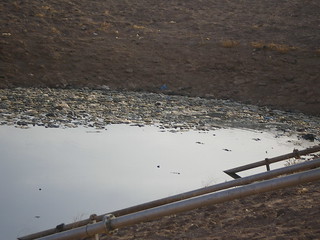
Image by Sustainable sanitation via Flickr

The continuing poor management of landfills in India is a disgrace, so it is no surprise that although we have seen evidence that there is growing interest in the scientific application of good leachate treatment practice in India, it would seldom be possible to apply it, given the unscientific way in which so called "landfills" (dumps?) are currently engineered and managed.

The following is an extract from an article on 24 April of this year (this month) on which I rest my case, since it is based upon the wealthy capital city of the nation:
Delhi government calls its three garbage dumps at Ghazipur, Okhla and Bhalswa landfills. In reality, they are far from what a landfill should be. These are monstrous trash mountains, including hazardous waste, leaching out toxic liquids and emanating noxious fumes. Thousands of scavenging birds swarm over them as they grow larger every day.

The situation could have been different had the corporations given more thought to managing them. Ask any waste picker who scavenges on these dump yards about why this waste could have been a treasure...
...there are hundreds of waste pickers who pick up whatever they can without using masks, gloves or any other protection. Some even tie a magnet to a long stick to pull up metal objects.
 Credits: Capital dumps a fortune at its landfills - Times of India
 
In my opinion the provision of proper waste disposal facilities should be on the very top of the agenda as any nation industrializes and becomes more wealthy. If India cannot devote just a small amount of it additional wealth which has been accruing at a historically uniquely rapid rate for more than the last ten years, then it is a failing state.

To deny pickers the ability to make a living can be an evil, but so many other nations (including many of lesser wealth) have found a way to recycle waste in a way that provides jobs for the local community without recourse to the life threatening and certainly extremely unhealthy practice of "picking".


At the same time, it has been possible to provide reliable leachate treatment and disposal once the landfills are properly managed and built in accordance with good sanitary landfill practices as have been acheived in the majority of nations around the world.

Providing successful leachate treatment plant designs in India, for the old existing dumps is an impossible task. That is because the prediction of leachate quality is rendered from scientific capability to a matter of guesswork by a lack of data and controls, and this is made even worse by India's monsoon climate which means that any leachate treatment plant needs to be able to run at almost no flow in the dry periods and very quickly at the start of each monsoon be able to treat it's maximum design flows.

As the most effective, and lowest cost forms of leachate treatment rely on biological processes and these cannot be quickly switched on therein lies another problem for leachate treatment in India.

Then finally, any leachate treatment plant designer for Indian landfills will discover that the water quality that the Indian government's own rules require the leachate to be treated to, are as strict, or require higher water quality after treatment, than even many authorities require in the wealthiest industrialized nations.

Unfortunately, waste management and especially landfill methods don't seem to get any better in India, despite increased wealth. They won't be able to do so, until the central Indian government revises the rules and makes them realistic, less strict but much better value for money, and appropriate to what the municipalities can afford to spend.

The 80/20 rule should be adopted, at least to start with for all future leachate treatment projects because by reducing the specifications for final water quality and using innovative solutions Indian landfill operators should be looking to spend 20% of the cost they are being quoted currently for leachate treatment plants for 80% of the treatment quality, and that treated quality would be good enough for the local rivers for the health of the rivers to which the leachate plants discharge, and for those using the water from them.

Friday, July 26, 2013

What Is Leachate? And How Is It Collected From The Bottom Of A Landfill?

Rainfall enters the landfill cell, and what isn't absorbed into the waste moves down to the basal filter. It passes through the pipe network, and rests in the sump. Pumps remove it from the sump, and may have to lift it 30 to 80 metres upward out of the top of the landfill. Make no mistake about how difficult this is. Even with modern pump technology to help, it is no easy feat to achieve this in the demanding conditions deep inside a landfill.

Leachate collection systems must be planned. The number, location, and size of the sumps are vital to an efficient operation of the landfill.

When designing sumps, the amount of leachate and liquid expected is the foremost concern. Areas in which rainfall is higher than average typically have larger sumps. This is called leachate management.

Leachate Management

A further criterion for leachate management sump planning is accounting for the pump capacity. The relationship of pump capacity and sump size is inversed. If the pump capacity is low, the volume of the sump should be larger than average. It is critical for the volume of the sump to be able to store the expected leachate between pumping cycles.

This relationship helps maintain a healthy operation. Sump pumps can function with preset phase times. If the flow is not predictable, a predetermined leachate height level can automatically switch the system on. Other conditions for sump planning are maintenance and pump drawdown.

Leachate Collection

Collection pipes typically convey the leachate by gravity to one or more sumps, depending upon the size of the area drained. Leachate collected in the sump is removed by pumping to a vehicle, to a holding facility for subsequent vehicle pickup, or to an on-site treatment facility.

Sump dimensions are governed by the amount of leachate to be stored, pump capacity, and minimum pump drawdown. The volume of the sump must be sufficient of hold the maximum amount of leachate anticipated between pump cycles, plus an additional volume equal to the minimum pump drawdown volume.

Sump size should also consider dimensional requirements for conducting maintenance and inspection activities. Sump pumps may operate with preset cycling times or, if leachate flow is less predictable, the pump may be automatically switched on when the leachate reaches a predetermined level.

Leachate Pipes

The leachate pipes should allow all the leachate to be pumped away, where it can be treated and the resultant slurry reintroduced either to the same landfill or sent to another. However, they can easily become clogged either by precipitation caused by chemical reactions due to the composition of the material that's in the landfill, or from a build-up of micro-organisms in the pipes, or due to the fact that unless designed correctly by experts the pipe walls may be crushed under the many thousands of tonnes of rubbish piled on top of them.

Summary

In the narrow environmental context leachate is therefore any liquid material that drains from land or stockpiled material and contains significantly elevated concentrations of undesirable organic and inorganic material derived from the material that it has passed through.


To prevent it building up inside landfills and escaping from the landfill liner, it has to be lifted out through  leachate collection system deep inside every modern landfill, using very robustly made pumps. This is an often costly challenge for pump manufacturers and landfill engineers alike, but the land around landfills and frequently also the drinking water supplies of the local people, depend upon this being done effectively both now, and for very many years into the future.

Find out more at the Leachate Website - www.leachate.co.uk.

Friday, July 31, 2009

Barr Environmental Explains the Background to the Garlaff Leachate Treatment Plant Project


The following is based upon an article about the latest Enviros designed and commissioned Leachate Treatment Plant, published in the July 2009 Edition of the Community Newsletter published by Barr:

Rain falling on the waste in a landfill is held within the plastic lining the waste sits on, which is intended to stop the rainfall entering the soil and rock beneath.

As site operator Barr Environmental needs to pump it out of the waste and treat it as per their SEPA waste permit. Till last year the leachate from the waste at Garlaff was treated in an open lagoon system close to the site entrance. While this plant still worked it was built many years back and wasn't able to treat the leachate to the highest standards now feasible. This old plant has been substituted by a state of the art treatment system beside Cell two of the rubbish heap.

The new plant is one of the most recent systems in the United Kingdom and was designed by leading leachate professionals Enviros. The consultants have designed over one hundred plants around the globe to treat this kind of waste water and have advised the UK govt and in particular the DEFRA government department in the Best Available Techniques (BAT) available for this kind of leachate treatment.

The plant is entirely automated and computer controlled and can nicely treat all of the leachate the landfill site produces every day. The system was built by Barr Surfacing & Civil Engineering and largely invisible from outside of the site as four fifth's of the plant is built below ground, rather like a below ground multi-storey car park.

The leachate is pumped from the rubbish heap from a series of wells in the waste to an large holding tank in the plant. There were some concerns about odour from this tank. So, all the tanks have been sealed at the top to stop any smells entering the air round the site before the leachate starts to be dealt with.

The main treatment tank is aerated and the leachate treated using the natural microbes in the sludge in the tank in the same way a sewage plant works. These microbes are specifically evolved to treat the ammonium rich liquid to provide a clean liquid that is fit for discharge to the brook.

The plant has been engineered to the most recent standards with a high efficiency energy rating that's achieved by insulating the tank with earth around it and transferring the heat from the aerators into the treatment liquid. Keeping up the leachate temperature through the winter at about 25 degrees C creates the ideal conditions for fast decrease in the pollutants within the aeration tank.

Still working with nature the final part of the treatment process uses natural reedbeds on site to shine and take away the last traces of solids and nitrogen.

The reedbeds have proven to be a helpful habitat as well to wildlife. They will quickly become home to many insects and the tiny birds that eat them.

Barr have been so happy with this new leachate plant that they have just built its twin at their other landfill site, at Auchencarroch in West Dunbartonshire, Scotland. Together these plants are the biggest and most modern leachate plants to ever be built in Scotland and controlled by one company.

The plants will operate for no less than the next 30-40 years till the leachate has been fully treated on the site and no longer is required to be removed.

Thursday, February 12, 2009

WRG Arpley Landfill Passes 1/2 Million Tonnes of Leachate Treated


From the WRG Newsletter

During early 2008, WRG’s Arpley leachate treatment plant passed a total of 500,000m3 of leachate treated. Since it was commissioned in October 2001, the plant has been treating very strong leachates which routinely contain greater than 2000mg/l of ammoniacal-N, to standards which allow safe discharge of effluent into the River Mersey.

When WRG took over Arpley Landfill in the spring of 1999, leachate was not under control. Although heads of leachate on the liner were limited to a maximum depth of 1 metre, levels were typically 7 or 8 metres, and well out of compliance. A key part of site remediation was investment of more than £1 million in a dedicated pneumatic leachate collection system, to automatically manage leachate levels in nearly 100 boreholes. From the start of 2001 leachates then began to be tankered off-site for treatment, at rates of up to 10,000m3 per month.

This allowed detailed pilot-scale treatability trials to be carried out by Enviros, to enable an optimum treatment scheme to be developed, which would represent the largest load of contaminants to be treated at any landfill site in the UK. WRG were no stranger to leachate treatment. In 1994, working with Enviros, a large leachate treatment plant had previously been designed and commissioned at Buckden Landfill near to Huntingdon, where a discharge consent into the sensitive River Great Ouse demands that rainbow trout shall be unharmed after 96 hours exposure to the final effluent. That plant continues to perform well, nearly 15 years later.

The treatment process adopted at Arpley (Plate 1) includes aerobic biological treatment of up to 450m3 of leachate each day, in three identical large Sequencing Batch Reactors. The SBR process has been pioneered for leachate treatment by Enviros, and shown to provide very stable and robust treatment of the very high ammonia and COD values which characterise leachates from large landfills. Effluent from the SBRs then passes through a Dissolved Air Flotation (DAF) process, which removes any remaining suspended solids. The treated leachate receives final “polishing” by passage through the root zone of extensive engineered reed beds, before being discharged safely into the River Mersey which flows beside the site.

WRG and Enviros worked closely with the Environment Agency to plan and implement the leachate treatment solution, and by 2004 leachate levels had been brought back into compliance with the site licence in every monitoring borehole. The plant remains a key part of controlled landfilling at Arpley, and continues to treat leachates at typical rates of 8,000 to 9,000 cubic metres per month.

Operation of all functions of the plant is completely automated. A programmable logic controller (PLC) provides maximum reliability, and the plant operator interfaces with this using a PC. Many dozens of failsafe systems, alarms, and telemetry links provide enormous security of operation. Experiences at Arpley have also formed the basis for many other large leachate treatment plants around the world. For example, Taman Beringin is a very large landfill located close to the centre of the city of Kuala Lumpur, in Malaysia. Remediation of the site has included a new leachate treatment plant (see Plate 2). It achieves very high effluent quality standards, which allow discharge of treated leachate to be made into a nearby watercourse.

As environmental standards at landfill sites are raised around the world, the ability to treat leachates reliably, and to high standards, remains critical, and WRG and Enviros are presently designing several new plants that will be commissioned during 2009.

Enviros is a UK-based full-service environmental consultancy, with an international reputation in wastes management. In the specialised field of landfill leachate management, the company has unique expertise, having worked on every continent except Antarctica, and has designed and commissioned more than 80 full-scale
leachate treatment plants throughout the World.

Monday, June 09, 2008

Enviros Commissions 3rd Leachate Treatment Plant in South Africa


Enviros Consulting landfill leachate treatment experts have successfully completed the commissioning of the new Leachate Treatment Plant for eThekwini Municipality's solid waste Disposal department (Durban Solid Waste - DSW).

The plant is treating leachate collected from the Buffelsdraai Landfill, which is a large new landfill located to the north west of the city. The site opened in May 2006 and receives the waste-stream that was originally accepted by the now closed La Mercy landfill site. The site will also accept waste previously disposed at other DSW landfills, including the large Bisasar Road Landfill.

The leachate treatment plant is planned to be completed in two stages with a treatment capacity of approximately 200 cubic metres per day, of which half has now been installed and commissioned.

The plant is the third biological treatment plant using a nitrification process similar to the many other Enviros plants, which Enviros has designed and commissioned in South Africa. It follows the commissioning of the Vissershok Leachate Treatment Plant (Cape Town City Council) and the Mariannhill Leachate Teatment Plant (Durban Solid Waste).

The leachate treatment plant protects the local river from contamination by leachate, which would if not treated, pollute the watercourse. Even if present at extremely low levels untreated leachate can cause taste problems in water later abstracted and treated for potable (drinking) water supplies.

The plant includes a reed bed for final water quality polishing, and will provide water for irrigation and for dust suppression.

Thursday, July 26, 2007

Kuala Lumpur Newspaper Applauds Enviros Designed Landfill Restoration & LTP

The following article refers to an Enviros concept designed landfill restoration for the local contractor, and an Enviros designed leachate treatment plant.

KUALA LUMPUR: A landfill which once marred Kepong has now turned into an unlikely success story.

A RM24 million campaign by City Hall has turned the rubbish hill into a picturesque mound covered with grass. While it was once shunned because of its terrible stench, it now attracts visitors.

On weekends, the Taman Metropolitan Kepong, a 120ha park located next to the former landfill, is packed with people.

Little do newcomers using the jogging track, extreme water sports facilities and a football pitch know of the malodorous history of the area.

For most, the hillock is a natural part of the terrain.

The excellent makeover was not just skin-deep. Under the pile of rubbish lie 1.8km of pipes that ring its perimeter and channel leachate into two containment pools.

This is then channelled to a treatment plant which in turn converts the leachate into clear, river-safe, water.

The build-up of methane gas from the landfill is also controlled by a series of pipes which allow gas to be released harmlessly.

The dumpsite in Taman Beringin is Malaysia’s first fully engineered landfill closure and rehabilitation project.

Rent and property value in the area have increased dramatically after the demise of the dump.

Residents in Taman Nyanyang, Taman Beringin and Taman Aman have been breathing a sigh of relief after enduring the horrible stench for most of their lives.

More here..

Tuesday, April 24, 2007

You are Invited to Our Leachate Treatment Plant Safari (2-Day Tour) - June 27 & 28

It has been a while since we posted to our blog and sent our email Newsletter to you.

That is because we have been very busy organising a Leachate 'Safari', among other things.

Come along with us and join us on our coach tour around the English Midlands, and the North of England, to bag 7 or 8 "big game"(?) leachate plants on 27 and 28 June (plants visited are subject to final itinerary).

OK, so you are right! The closest to a game reserve that we will get to will likely be a "Reserved for the Site Manager" sign in a landfill site car park. Sorry, but we did not think you would be able to afford the cost, or the time of a trip, to see our plants in South Africa. Also, we wanted to make it at least SOUND more interesting to get your attention! (Tell us if we are wrong!)

In all honesty though, this is a rare and very valuable opportunity, which I think you will appreciate now that we have grabbed your attention.

What we can promise you during this conducted and very full 2 day tour, is the opportunity to see a range of Enviros designed leachate treatment plants, and a range of treatment technologies. You will see them operating, and we would expect the plant operators to join us to tell us about their plants during each visit, just as they have on past safaris (although we cannot guarantee this).

There will also be a number of Enviros leachate treatment experts on the tour and present to ask questions throughout. (These are likely to include Howard Robinson, Steve Last, Martin Carville, and Gwyn Harris.)

All the time, while on the coach there will also be many other leachate and landfill management professionals prsent, making this an unrivalled opportunity for newcomers to talk "leachate management". You will very quickly assimilate a lot of information about leachate, and how to manage it, in real-life situations.

(If you need to remind yourself about the types of biological SBR and related processes we provide just visit www.leachate.co.uk.)

During this trip we will also be celebrating 25 years of leachate treatment consultancy, designing, procuring and tendering, supervising construction, and most importantly TRAINING the future plant operators, while we process commission the plants with them.

Yes, we give all the biological process operating sklls we possess to the staff on site, all the tricks we know to keep the bugs (biomass sludge) treating and producing a superb effluent quality, and commissioning is done all the time with the site staff. At times this seems crazy. Where is the business sense for Enviros in that? After all, once trained we are no longer needed, and not many other treatment plant experts would do this.

Nevertheless, this has been good business for us, and the value of this to our clients is undeniable, and there are always new sites and new clients to design for.

As there is good reason to celebrate, there will be a dinner provided on the first evening in a historic Shrewsbury Hotel, in Shropshire. All meals and transport are provided, and accommodation is booked for you.

Full details are available on our web site at www.leachatesafari.com so please visit that site and register, either on-line or download, print, and send, the completed form on the .pdf copy of our leachate brochure which is available online. There is a small charge to cover our costs, and payment must be made in advance.

Oh! and please do also SUBSCRIBE giving us your email address on that Blog site (www.leachatesafari.com) for our Safari Newsletter so that we can keep you updated, even if you are unsure about attending just now, and just wish to think about this opportunity you should still subscribe for more news at www.leachatesafari.com .

We do hope you will attend this tour. We are looking forward to your company on this trip.

DO BOOK EARLY, though as there are no more than 45 places, and there can only be one coach full only. Miss this now, and it might be another 5 years before there is another!

From your web master - Steve Last (Enviros Consulting)

Wednesday, January 17, 2007

EA Says - Environment Not to be Considered as a Recipient of Pollutants and Waste

The UK Environment Agency's implementation of IPPC Regulations is progressing and the draft Guidance for the Treatment of Landfill Leachate Final DRAFT - Sector Guidance Note IPPC S5.03 is available on their web site here.

This is now (at 187 pages) an even longer document than the orginal draft, but it is now a significant reference document and source of information for all those interested in leachate treatment in the UK, and being freely available for downloading is also likely to be used in many other nations.

The EA does state that:

The BAT approach requires us not to consider the environment as a recipient of pollutants and waste, which can be filled up to a given level, but to do all that is practicable to minimise emissions from industrial activities and their impact.

For those unfamilar with the concept of BAT, BAT stands for Best Available Techniques. What constitutes a best available technique for the treatment of leachate is fully explained in the guidance document. The use of the word technique is broader than would be indicated if the word process had been used instead of technique, and means that a combination of a proven process and optimum implementation of the process is important when establishing that a treatment process is BAT.

Why is BAT important? It is important because the BAT philosophy is central to the UK's implementation of IPPC.

Who does the Guidance apply to? Everyone with leachate to discharge, or tanker away, from an IPPC regulated landfill.

Here is the context for the quotation above, which we have copied from the guidance:-

BAT and Environmental Quality Standards (EQS )

The BAT approach complements, but differs fundamentally from, regulatory approaches based on Environmental Quality Standards (EQS).

Essentially, BAT requires measures to be taken to prevent emissions - and measures that simply reduce emissions are acceptable only where prevention is not practicable. Thus, if it is economically and technically viable to reduce emissions further, or prevent them altogether, then this should be done irrespective of whether or not EQSs are already being met.

The BAT approach requires us not to consider the environment as a recipient of pollutants and waste, which can be filled up to a given level, but to do all that is practicable to minimise emissions from industrial activities and their impact.

The BAT approach first considers what emission prevention can reasonably be achieved (covered by Sections 2 and 3 of this Guidance) and then checks to ensure that the local environmental conditions are secure (see Section 4 of this Guidance and also Guidance Note IPPC Environmental Assessments for BAT).

The BAT approach is therefore the more precautionary one because the release level achieved may be better than that simply required to meet an EQS.

Conversely, if the application of indicative BAT might lead to a situation in which an EQS is still threatened, a more effective technique is required to be BAT for that installation. The Regulations allow for expenditure beyond indicative BAT where necessary, and, ultimately, an installation will only be permitted to operate if it does not cause significant pollution.

Several new leachate treatment technologies have now been included in the guidance. We will post again soon with further information on the technologies within this guidance.

Please add a comment, and respond with your views on this post - or simply encourage us to follow up with more discussion of this important UK leachate guidance. (It is easy to comment - just click on the word COMMENT below this posting, and complete the form.)